Plans for a new law have been announced which is set to affect all households without driveways across the UK for the better.
A change in the rules for charging EVs at home will make it ‘easier and cheaper’ for both renters and for those who don’t have a private driveway, the government says.
The new law, should it be put in place following a consultation period, will make it mandatory for leaseholders to install EV charge points in covered car parks. It will also scrap planning permission rules on pavement charging points, which the Government says will save drivers £250 in application fees, while allowing EV owners to access lower, standard domestic electricity prices.
The changes will give more drivers access to standard household electricity rates instead of having to use more expensive public chargers. Relying on a cheap EV tariff at home instead would make running an EV cost 2p per mile, or ‘the equivalent of London to Birmingham for £2.50’, the Department for Transport said.
How EV owners can get around the ‘pay per mile’ tax
Much of the public charger growth has been seen outside of London, with the number of devices installed outside of the capital growing by 24.3%, compared to 21.7% within it.
In a Department for Transport consultation on the plans released in November, the Government said its plan to build ‘cross pavement’ EV charging would open up the cheap 2p rates to more homes and drivers.
It said: “Reliable and comprehensive charging infrastructure is needed to support the transition to zero-emission vehicles. The majority of EV charging takes place at home, and we expect this to continue. As the number of EVs on the road increases, government wishes to ensure that legislative frameworks support chargepoint installations in a timely and affordable manner.
“Charging an electric vehicle at home is the most convenient and affordable option for most drivers, and the majority of EV charging currently takes place at residential properties. However, many households do not have access to off-street parking, making it difficult to access domestic EV charging.
“For certain dwellings, a cross-pavement solution is a system that enables a safe passage between a home chargepoint and a vehicle parked on the street. It typically does this by allowing a charging cable to cross the pavement in a way that minimises trip hazards and maintains accessibility for pedestrians.
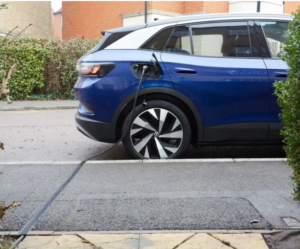
“The use of cross-pavement solutions helps to minimise and remove the dangers associated with trailing cables across public footways, which can pose risks to pedestrians, especially those with mobility or visual impairments.
“Permission for a cross-pavement solution is required from a local authority. Current law requires up to 3 separate permissions.
Under the proposed changes, planning permission would be granted nationally via PDR. Those seeking to install a cross-pavement solution would not be required to submit a planning application. Section 178 permission and street works permissions would still be required for the installation of a cross-pavement solution.”
It went on to add: “To ensure everyone can benefit from reliable and cost-effective EV charging, including those who have accessible on-street parking, the government is therefore consulting on introducing a PDR for cross-pavement solutions and also a dedicated chargepoint…
“These proposed changes will help ensure that more people can access affordable and safe EV charging at home, supporting the transition to zero-emission vehicles.”
Transport Secretary, Heidi Alexander, said: “Wherever you park your car, we’re making it fairer, easier, and cheaper to make the switch to electric.
“These reforms will improve infrastructure for the EV revolution, increase chargepoints across the country and open up affordable home charging to thousands more households.
“It’s good news for drivers and a big boost for the growing British EV industry – cutting costs and supporting jobs to deliver our Plan for Change.”